THE 1914-1918 GERMAN CROSS OF HONOR (HINDENBURG) -
Paul von Hindenburg (2 October 1847 � 2 August 1934) was a German field marshal, statesman, and politician, and served as the second President of Germany from 1925 to 1934.
Hindenburg enjoyed a long career in the Prussian Army, retiring in 1911. He was recalled at the outbreak of World War I, and first came to national attention, at the age of 66, as the victor at Tannenberg in 1914. As Germany's Chief of the General Staff from 1916, he and his deputy, Erich Ludendorff, rose in the German public's esteem until Hindenburg came to eclipse the Kaiser himself. Hindenburg retired again in 1919, but returned to public life one more time in 1925 to be elected as the second President of Germany.
Though 84 years old and in poor health, Hindenburg was persuaded to run for re-election in 1932, as he was considered the only candidate who could defeat Adolf Hitler. Hindenburg was re-elected in a runoff but nonetheless played an important role in the Nazi Party's rise to power, dissolving parliament twice in 1932 and eventually appointing Hitler as Chancellor in January 1933. In February, he issued the Reichstag Fire Decree which suspended various civil liberties, and in March he signed the Enabling Act, in which parliament gave Hitler's administration legislative powers. Hindenburg died the following year, after which Hitler declared the office of President vacant and, as "F�hrer und Reichskanzler", made himself head of state.
 |
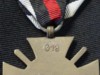
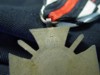
The Honor Cross was instituted by Generafeld Marschall Von Hindenburg on July 13th 1934. The official designation for the award is "The Honor Cross of the World War 1914-1918". However, the medal is better known
as the "Hindenburg Cross".
The medal's design was the creation of Eugene Godet of Berlin, who received specific directions from the
Third Reich Chancellery for its creation. The cross measured 38 mm. Later, a comercial version became
available in pin back form and measuring only 31.5 mm.
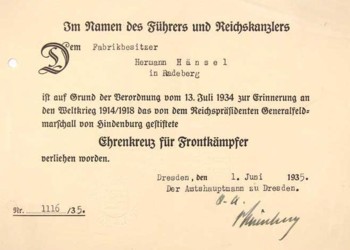
The cross was presented with an award document. The manner of presentation varied. Sometimes it was handed
in a basic envelope. Other times it came in a binder (award document on one side, medal on the other). The
last format was in a case. This is the only award issued during the Third Reich recognizing service provided during WWI.
|
This service is provided free of charge to the visitor/enthusiast courtesy of
MilitaryItems.com,
a company dedicated to the preservation of military history and to providing quality
military antiques and collectibles to museums, institutions and the general public.
The award came in three formats:
| AWARD TYPE |
DESCRIPTION |
| Combatants "Fur Fron-tkamper" |
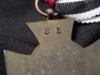
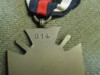
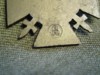
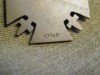
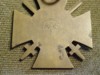
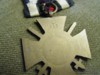
This was a bronze cross with the date 1914-1918 in the center surrounded by a laurel leaf wreath. Two crossed swords
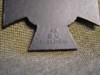
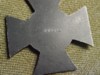
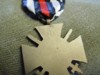
ran between the arms of the cross. The back of the cross was plain with the exception of the manufacturer marking.
In some cases the marking was not present.
The ribbon consisted of colored stripes in the following pattern: Black/White/Black/Red/Black/White/Black
The number of medals approved and rendered as of February 1st 1937 were as follows:
Combatant: 6,202,883
|
| Non-Combatants "Fur andere Kriegsteilnehmer" |
Same as above but without any swords.
The number of medals approved and rendered as of February 1st 1937 were as follows:
Non-combatant: 1,120,449
|
| Widows or Parents "fur Witwen und Eltern" |
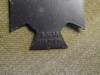
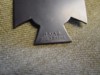
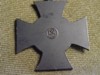
This cross was finished in black. The susoension ribbon was White/Black/White/Red/White/Black/White.
The number of medals approved and rendered as of February 1st 1937 were as follows:
Widow: 345,112
Parent: 373,950
|
|