WWII JAPANESE ARMY SAMURAI SWORD - #2 - This is a WWII Katana. The Katana sword was
developed during the Azuchi-Momoyama period, between 1574 to 1602. These types of swords
measure between 24" to 30".
The Katana is one of the most recognizable swords in history. Its strength, simplicity in
design and out right beauty has elevated it to be one of the top military antiques and
is highly collectible.
Most of the swords found in the United States were war souvenirs brought back by soldiers
after the end of WWII.

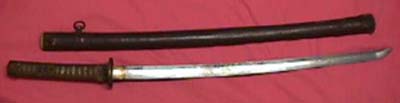
This is a picture of the Katana outside of the scabbard. The swords were designed to
fit loosely inside the scabbard. The sword was worn slung through the belt with the
curve facing down.

|
The Samurai sword has a very rich history. The sword has been manufactured for several centuries and continues
to be produced today. The sword represented more than just a weapon. It was the soul of the Samurai warrior.
When attempting to identify the type of sword you have It is important to keep in mind that the fittings of
a sword (scabbard, handle, crossguard. etc.) may be identical from one sword to another. The reason why is
because during WWII the same fittings were used in all Army swords, Navy swords, etc. Armed forces are all
about uniformity. They strive to make everything the same.
This is the reason why a sword cannot be identified merely by its external appearance.
Understanding the different components that make up the Samurai sword is the first step in figuring out the
type of sword you have. That is the reason why we have created the
Understanding the Samurai sword section as a means to
provide a novice with the basic knowledge to start the path of determining the questions everyone has;
who made the sword, how old it is nad how much it is worth.
|
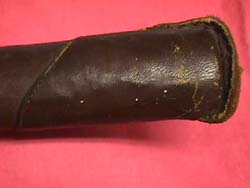
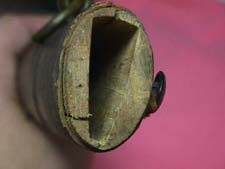
The wooden scabbard with a brownish leather cover are traditional mountings of the
WWII period. A side view of the leather strap is seen on the left picture. The bottom
of the scabbard has a simple leather design to it (right photo).
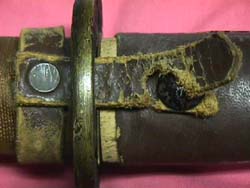
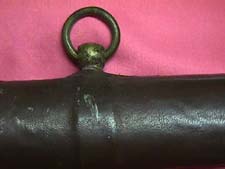
The mid section of the scabbard can be seen here. The leather has been cut to allow the hanger
loop to go through. Underneath the leather the wood from the scabbard is visible.
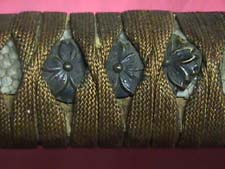
The three cherry blossom menuki is also a typical mounting of the japanese armed forces
during WWII. The menuki is often a highly decorative piece portraying figures of dragons,
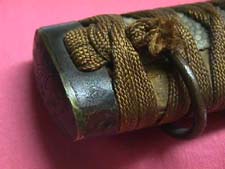
skulls, insects and many other characters. The picture on the right illustrates the "tachi" hardware.
|
WE BUY JAPANESE SWORDS - All types of Japanese edge weapons. Whether it is a WWII era Samurai sword or an
older type of blade.
The process gets started by you sending us an
Email .
We will respond to your inquiry normally within 24 hours and in many cases much faster.
We can tell you what you have, what it is worth and how much we can pay you.
One sword or an entire collection -
Email Us .
|
 |
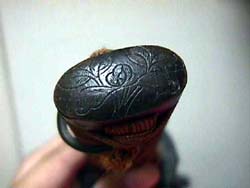
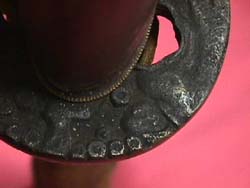
The pommel cap (Kashira) came in a variety of designs or simply plain. the example shown
here depicts a flowery scene. The purchaser had a choice as to the complexity of the design.
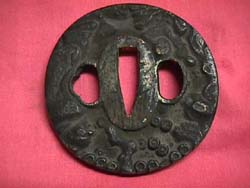
The leather fastener with a snap is used to hold the blade in place. The wooden
scabbard shows as the leather cover has receded due to aging. A clear view of the
tsuba (hand guard) is displayed here.
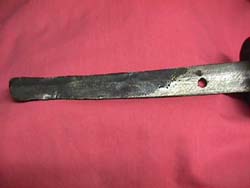
The set of pictures below shows some of the components of a sword. A wooden peg would go through
the hole in the tang to secure the blade to the handle. Soldiers would often make the peg by
inserting a chop stick in the hole of the tang, then proceeded to break it.
swords often displayed the signature of the maker, their title and school or village on the tang.
The example shown here is not signed.
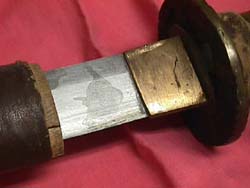
The photo on the left shows the Habaki. Normally manufactured of copper. It was designed to
hold the sword in place when put in the scabbard. Soldiers with the necessary means could have
the Hamon covered with gold foil. The Hamon is secured between the nothes at the base of the
blade and the Tsuba.
|
This page is a recognition and identification guide for Samurai swords.
Multiple detailed photos of a specific sample are provided. Descriptions point
out clearly defined points that should be noted.
One of the most commonly asked questions is "How much is my Samurai Sword worth?".
A price guide is included here to address this question. The value of the swords is
reviewed over a period of several years. A trend can be observed. The present worth
of the edge weapons in the collector's market is illustrated.
This service is provided free of charge to the visitor/enthusiast courtesy of
MilitaryItems.com,
a company dedicated to the preservation of military history and to providing quality
military antiques and collectibles to museums, institutions and the general public.
|
|
By the Numbers
It is next to impossible to determine the exact number of Samurai swords that were produced and issued to
Japanese soldiers during the war. However, thanks to the record keeping maintained by the US Armed Forces,
it is possible to estimate how many swords were actually shipped home.
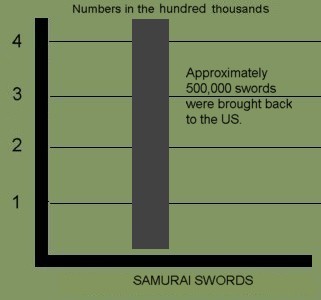 |
There were over 500,000 Samurai swords were brought back home as souvenirs from the war.
There are several caviats to this number.
|
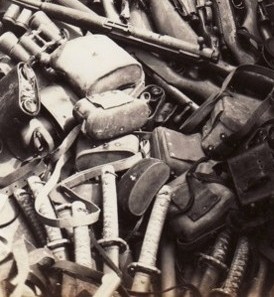 |
For example, some soldiers took souvenirs and shipped them home circumbenting the established process.
Some of the swords were brought back inside duffle bags without anyone knowing except for the soldier who
captured the sword. This fact would clearly affect the final count.
The number also does not account for swords that were taken by Allied soldiers from other countries.
Collecting Samurai swords
Collecting Samurai swords is a field that has been growing since the days the GI's rummaged around Asia
bringing back military souvenirs. Japanese soldiers carried many of these swords when they went to
battle. Once the soldier was killed or captured, the Americans would take the edge weapons as war trophies.
Eventually all these pieces came back to the United States where military history enthusiasts began to collect them.
 |
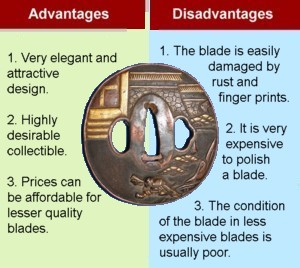
In trying to determine if you should collect Samurai swords there are certain factors that should be
considered.
The adjacent table outlines some of the advantages and disadvantages of collecting the Samurai swords.
|
 |
This Samurai Sword may be currently reproduced.
It is becoming more difficult to be able to tell the fake ones from the real ones because
the quality of the reproductions is improving. The collector must become familiarized with
the construction style and materials employed in the manufacturing of this item.
Attention to the details is critical in order to be able to determine the authenticity of
the collectible.
If you have an interest is seeing other Japanese Samurai swords, you can do so by going to our
Japanese Samurai Swords Price Guide
identification guide. Where we cover Samurai swords from all periods.
| 





 Click on the sword for additional details !