|
WWII JAPANESE ARMY SAMURAI SWORD - KATANA - #5
The Samurai sword has captured the imagination of people for hundreads of years. Its legendary strength,
simplicity in design and outright beauty have earned it a top place among military antiques and collectibles.
Many of these swords were brought back to the US as war souvenirs by returning soldiers after WWII ended.
The sample shown here is a Japanese WWII Samurai sword. Very representative of those issued to the armed
forces in WWII.
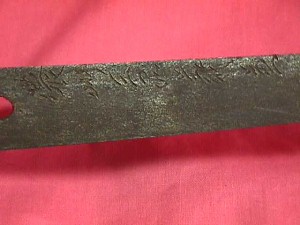
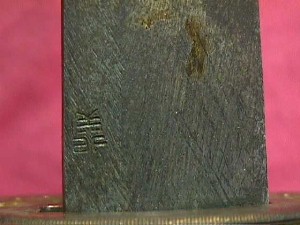
The swords were often marked in the tang section. The pictured below illustrate some of those markings.
Among the information placed there include the date in which the sword was made, the name of the maker, Name
of the town or school where it was made.
The sword here also has an arsenal marking, which is shown on the right side photo.
|
This page is a recognition and identification guide for Samurai swords.
Multiple detailed photos of a specific sample are provided. Descriptions point
out clearly defined points that should be noted.
One of the most commonly asked questions is "How much is my Samurai Sword worth?".
A price guide is included here to address this question. The value of the swords is
reviewed over a period of several years. A trend can be observed. The present worth
of the edge weapons in the collector's market is illustrated.
This service is provided free of charge to the visitor/enthusiast courtesy of
MilitaryItems.com,
a company dedicated to the preservation of military history and to providing quality
military antiques and collectibles to museums, institutions and the general public.
|
|
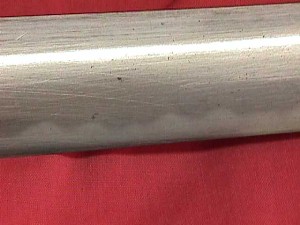
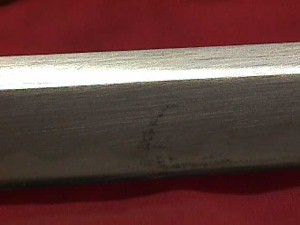
The temper line (Hamon) is still visible in this sample. This line was used by the maker as a way to personalize
the sword. It was sort of an informal signature. The shape of the temper can help you determine the master
who created the sword.
The horizontal marks across the blade are an indication that a previous owner attempted to sharpen or polish
the blade in an incorrect manner. Sharpening these type of swords require great skill. An owner should never
attempt this unless he/she has had previous training.

|
The Samurai sword has a very rich history. The sword has been manufactured for several centuries and continues
to be produced today. The sword represented more than just a weapon. It was the soul of the Samurai warrior.
When attempting to identify the type of sword you have It is important to keep in mind that the fittings of
a sword (scabbard, handle, crossguard. etc.) may be identical from one sword to another. The reason why is
because during WWII the same fittings were used in all Army swords, Navy swords, etc. Armed forces are all
about uniformity. They strive to make everything the same.
This is the reason why a sword cannot be identified merely by its external appearance.
Understanding the different components that make up the Samurai sword is the first step in figuring out the
type of sword you have. That is the reason why we have created the
Understanding the Samurai sword section as a means to
provide a novice with the basic knowledge to start the path of determining the questions everyone has;
who made the sword, how old it is nad how much it is worth.
|
Serious collectors will send the swords back to Japan or selected areas in the US to be polished. This
is part of the restoration process. Polishing also sharpens the edge. Polishing a blade costs over
$100.00 per inch.
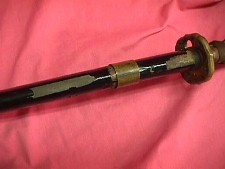
The scabbard is wooden and the lacker paint shows some wear.
Some sections are peeling off near the hanger and the throat. This is a traditional scabbard
as opposed to the metal covered military scabbard.
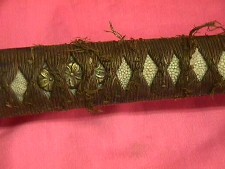 |
The handle wrapping is typical of the one used by the Imperial Japanese Army. The
wrapping shows some freying. The Menuki is clearly visible. It shows the three Chrisantemums,
which is the correct style for the Japanese Imperial Army during WWII.
The finish on the scabbard is coming off revealing some of the wooden base. Brass fittings are
applied at the mid-point.
|
 |
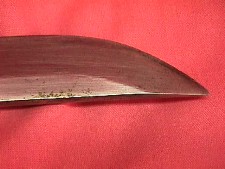
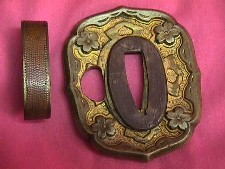
The tip of the blade has some small rust spots. The picture on the
right shows the Tsuba, which is the type employed by the Japanese armed forces.

|
WE BUY JAPANESE SWORDS - All types of Japanese edge weapons. Whether it is a WWII era Samurai sword or an
older type of blade.
The process gets started by you sending us an
Email .
We will respond to your inquiry normally within 24 hours and in many cases much faster.
We can tell you what you have, what it is worth and how much we can pay you.
One sword or an entire collection -
Email Us .
|
 |
The Katana sword was developed during the Momoyama period. It was normally 24" to
30" in length.
By the Numbers
It is next to impossible to determine the exact number of Samurai swords that were produced and issued to
Japanese soldiers during the war. However, thanks to the record keeping maintained by the US Armed Forces,
it is possible to estimate how many swords were actually shipped home.
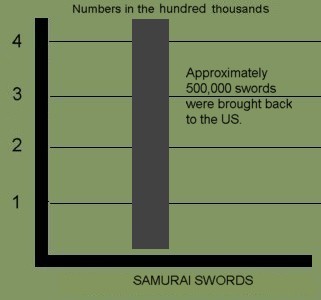 |
There were over 500,000 Samurai swords were brought back home as souvenirs from the war.
There are several caviats to this number.
|
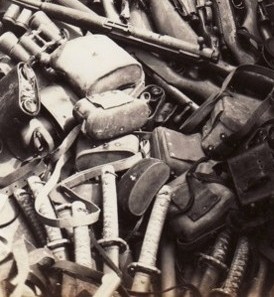 |
For example, some soldiers took souvenirs and shipped them home circumbenting the established process.
Some of the swords were brought back inside duffle bags without anyone knowing except for the soldier who
captured the sword. This fact would clearly affect the final count.
The number also does not account for swords that were taken by Allied soldiers from other countries.
Collecting Samurai swords
Collecting Samurai swords is a field that has been growing since the days the GI's rummaged around Asia
bringing back military souvenirs. Japanese soldiers carried many of these swords when they went to
battle. Once the soldier was killed or captured, the Americans would take the edge weapons as war trophies.
Eventually all these pieces came back to the United States where military history enthusiasts began to collect them.
 |
In trying to determine if you should collect Samurai swords there are certain factors that should be
considered.
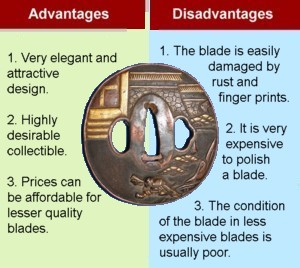
The adjacent table outlines some of the advantages and disadvantages of collecting the Samurai swords.
|
 |
This Samurai Sword may be currently reproduced.
It is becoming more difficult to be able to tell the fake ones from the real ones because
the quality of the reproductions is improving. The collector must become familiarized with
the construction style and materials employed in the manufacturing of this item.
Attention to the details is critical in order to be able to determine the authenticity of
the collectible.
If you have an interest is seeing other Japanese Samurai swords, you can do so by going to our
Japanese Samurai Swords Price Guide
identification guide. Where we cover Samurai swords from all periods.
| 



 Click on the sword for additional details !