|
WWII Japanese Army China Incident War Medal -
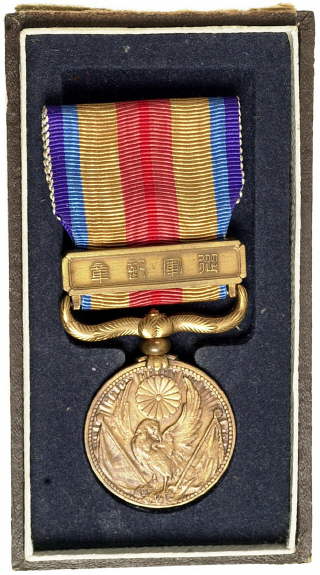
This is a WWII Japanese China Incident Medal.
| Creation date: |
July 27, 1939 (according to imperial Edict #496) |
| Amendments: |
1944 (Edict #418) |
| Abolished: |
1946 (Government ordinance #177) |
An incident occurred at the Marco Polo bridge near Peiping on the 7th of July, 1937. This event
triggered a series of actions that would culminate with the invasion of China by Japan. The cost
in lives was measured in the hundreds of thousands. The "incident" ended with the eventual surrender
of the Japanese forces in 1945.
The war medal was awarded to soldiers departing for service in China. It was issued clear until 1945.
The medal was not to be awarded to soldiers who received the Great East Asia War Medal.
The construction of the medal consists of 30 mm bronze, with a swivel grip. The front of the medal
depicts the "Yata-no-karasu" (mythical bird) on crossed Army and Navy flags. Complete with rays of light
behind and the Chrysanthemum crest above.
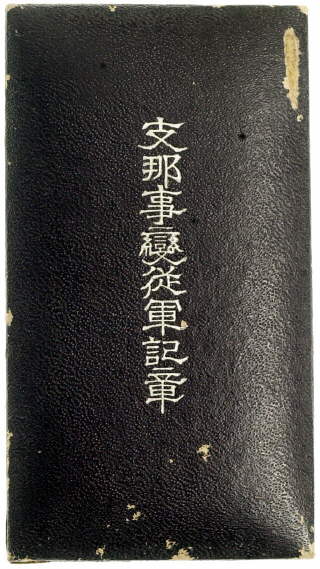
The back of the medal portrays mountains, clouds and waves. The meaning behind this symbology is
Northern China, Central China and the red Sea. The inscription reads "China Incident".
The "Yata-no-karasu" is a giant three legged mythical red crow which, according to legend, guided
Jimmu Tenno's army through the mountains. In designing the medal, the decision was made to depict
the bird with only two legs.
The ribbon is 37 mm wide, watered, with the following pattern and meaning:
- 3 mm of blue - The sea and the Navy
- 3 mm light blue - The sky and the Air Force
- 7.5 mm tan - The red Chinese soil, for the Army
- 3.5 mm dark pink - The blood staining the Chinese soil
- 2 mm bright red - Blood and loyalty
The ribbon bars were manufactured with the pink stripes changed to a maroon color. However, the
ribbon was not worn with the medal.
The case is black pasteboard bearing the name of the medal in silver characters.
|
|
This page is a recognition and identification guide for Japanese WWII medals.
Multiple detailed photos of a specific sample are provided. Descriptions point
out specific points that should be noted.
One of the most commonly asked questions is "How much is my Japanese medal worth?".
A price guide is included here to address this question. The value of the WWII gear is
reviewed over a period of several years. A trend can be observed. The present worth
of the items in the collector's market is illustrated.
This service is provided free of charge to the visitor/enthusiast courtesy of
MilitaryItems.com,
a company dedicated
to the preservation of military history and to providing quality military antiques and
collectibles to museums, institutions and the general public.
|
|
Many WWII Japanese medals are currently
reproduced.
It is becoming more difficult to be able to tell the fake ones from the real ones because
the quality of the reproductions is improving. The collector must become familiarized with
the construction style and materials employed in the manufacturing of this item.
Attention to the details is critical in order to be able to determine the authenticity of
the collectible.
If you have an interest is seeing other WWII Japanese items, you can do so by going
to our WWII Japanese Collectibles
identification guide, where we discussed items from different groups and organizations.
|





 Click on the sword for additional details !


